Before my trip to India I read "India (CultureShock!): A Survival Guide to Customs and Etiquette". I found the book to be entertaining and I am glad that I read it, but I did not think it was too informative. It seemed to me that it was more aimed at people moving to India, not at casual travelers. Anyway, I learned a bit from the book, and even more from my personal experience, so I am going to share it here.
Here is my list of do's and don'ts for Indian travel:
Behave and dress modestly. Especially when visiting temples and mosques.
Remove your shoes when entering a temple, a mosque, or someone's house.
In mosques cover your head with a scarf.
Do not point bottoms of your feet towards any other person or images and statues of gods. (It is considered to be highly disrespectful and offending.)
Treat elders with special respect.
Greet Hindus with "Namaste" or "Namaskar", and Muslims with "Salaam Alaikum".
Do not hug, kiss or shake hands with a person of the opposite sex, unless it is initiated by the other person.
When in public, do not show any signs of physical affection towards the member of the opposite sex.
Do not bring alcohol to an Indian household, unless you are 100% sure that your hosts will appreciate it.
Observe the behavior of others and use it as a guide to your own behavior.
Do not expect anything to happen on time.
Do not use the left hand to eat, sign important documents, pass money or gifts. Left hand is considered to be inauspicious.
In restaurants (in India called "hotels", btw), leave a small tip. It does not have to be the customary American 20%, just round it up to the nearest higher number.
When renting a rickshaw or any other service, agree on a price beforehand. That might be the only way to avoid being overcharged.
In places where bargaining is appropriate (like street bazaars), start the negotiations with 30-50% of the price you are being quoted. Less than that could be considered offending. If a seller agrees on your price, buy it. It would be highly disrespectful of you to simply bargain for fun and then not to buy the item if your price was met.
Be polite, but firm, if you are not interested in buying something. In my experience, the best way to decline somebody's offer politely is to say: "I already have it, and I do not need another one of those."
Don't bargain in proper shops especially those that display "Fixed Price" signs.
Never leave your belongings out of your sight. Especially on the trains. Check out my tips on the train travel here and here.
Drink only boiled or bottled water, and eat foods that were boiled. For more tips on Indian food, check out my post dedicated to it.
I was amused and somewhat proud to find out that before my trip to India Anil's mother initially did not want me to stay at their family house as "it could ruin Anil's reputation". Apparently, if the news that a white woman stayed at their house would spread, his chances of marrying an Indian girl would be close to zero. Since Anil was never interested in marrying anybody of Indian origin, I decided to insist on staying at his parents house.
You may think that it was culturally insensitive of me to do that, but from my point of view the primary reason to go to India was to visit and get to know Anil's parents. If I had stayed elsewhere, it would have been much more difficult to achieve that goal.
In the end Anil managed to convince his mother to let me stay with them, his reputation did not get ruin, he did not have to marry any Indian girl, moreover we got married and I became a heroin in a medieval love story... ;)
Before my trip to India one of my generous co-workers lent me several of her beautiful Indian outfits. She recommended that I wear her silk salwar kameez on a day I meet Anil's parents. I followed her recommendation and here I am on my first day in India at their house:
In this beautiful outfit I felt like an Indian princess (despite the blond hair...) :)
I find Indian clothes immensely beautiful, and I am very impressed by the bold color combination that is common in Indian designs. However, if you know me, you know that my style is much more conservative and that the base color of most of my outfits is black.
Black clothes are rare in India and it is not easy to find them in the traditional shops. But, luckily for me, the luxury modern shopping malls carry some Westernized designs that occasionally use black. I was so happy about that, that I went a bit crazy and in just two hours at the mall I bought all the clothes that you can see at the photo below. At least these were money well spent, as I am wearing those clothes every day:
I'm very glad that I managed to find Indian clothes that perfectly fit my style. Thanks to that, even though I do not wear saris, Anil's mother does not try to influence what I wear and even compliments my style by saying that my clothes are more modest than the ones of many young Indian girls. (She is from older and more conservative generation, so for her the sole purpose the clothes should serve is to cover as much of a body as possible.)
If you take a closer look at my photos from India, especially the ones from Hyderabad, you will notice that almost all Indian women wear traditional Indian clothing (mostly saris or salwar kameez), whereas almost all Indian men wear Western-style clothes (trousers plus shirt).
I was very impressed that women were able to ride motorbikes, carry out all household chores and even do heavy-duty construction work wearing saris. At the same time, I found it a bit disappointing that men were not wearing traditional clothes. It seems that men would only wear traditional Indian clothing (Dhoti, Lungi or Kurta) for more official occasions.
The most traditional female Indian clothing is a sari (saree). It is a strip of unstitched cloth, ranging from four to nine meters in length that is draped over the body in various styles (the most traditional saris are 9 m long). The sari is usually worn over an ankle-length skirt called "petticoat" and a blouse called "choli". Cholis usually are short and end just under the breasts. They may be backless or of a halter neck style and have short sleeves. In contrast to pettitcoats, which are plain, cholis are usually decorated with a lot of embellishments such as mirrors or embroidery.
There are many styles in which saris can be draped. The most popular of them is the nivi drape:
As you could see on the video, in the nivi style one end of the sari (the undecorated one) is tucked into the waistband of the petticoat. The cloth is wrapped around the lower body once, then hand-gathered into even pleats (usually 5-7 pleats, each around 5 inches/12cm long). The pleats are tucked into the waistband of the petticoat in a way that the bottom part of the sari just barely touches the floor. After one more turn around the waist, the loose end of the sari (called the pallu) is draped over the left shoulder. The pallu may either be left hanging freely, tucked in at the waist, or used to cover the head or the neck. Typically, the pallu is left handing freely, which highlights the beauty of the sari as the pallu is often intricately decorated.
If you watched the video till the very end, you saw the Gujarati style of drape, in which the pallu is draped from the back towards the front. Personally, I do not like this style and I find the nivi drape much more elegant and female.
Here is another video showing how to tie a sari, in case you would like to practice :)
In case you think that figuring out how to put on the sari is the difficult part, you are wrong. The difficult part is figuring out how to walk in it and how to wear it gracefully.
The very first sari that I ever wore was my wedding sari. As soon as I bought it I started practicing draping it nicely around myself. After just a few tries, I felt confident that I could do it pretty well. But then I realized that also walking in a sari, and especially sitting down, without disturbing the drape is difficult! It is particularly difficult in a wedding sari, which is heavily-decorated and weighs several kilos. Additional challenge is that a sari should always be floor-length, which might mean that you will have to re-drape your sari if you are planning on switching between wearing high-heel shoes and being barefoot. Just something to remember if you plan to visit other people's houses and will be removing your shoes... I guess that explains why most Indian women wear flat-heel shoes.
If you are a first-time sari buyer, my advice would be to pick a sari that is light and made from a synthetic and soft material. The softer the material, the easier it will be for you to drape it around yourself. Usually, this kind of a sari would be called a "work sari" and would not be too expensive. Do not forget to get a matching pettitcoat and a choli for it as well!
Once you start feeling more comfortable wearing saris, you should go ahead and buy yourself a traditional silk sari. They come in a variety of colors and patterns, and are worn during official ceremonies and social gatherings.
Below are a few pictures of my wedding sari. As you can see on the first two photos it took several people to help me put it on before the ceremony:
On this photo Neeta, my sister in law, is putting a safety pin through my sari to make sure that it won't open during the ceremony:
Here is my wedding sari in the full glory. The part that is hanging over my shoulder is called a pallu:
Sitting on the floor in a sari is not easy! If you watched the videos carefully, you will remember that twice the material is draped around your waist. If you do it too tightly, you won't be able to sit down:
Another challenge during an Indian wedding ceremony is that it involves a lot of cycles of walking and sitting down. Moreover, the rim of my sari and of Anil's dhoti got tied together, which meant that we had to synchronize standing up and walking... Good practice before the marriage ;)
Here, Neeta helps me grab my sari in a way that it will not fall apart if Anil pulls it too hard:
During the religious part of an Indian wedding ceremony it is still expected that a woman wears a sari. However, as soon as this part is over, it is acceptable (and common) for women to change into other, more-comfortable outfits, e.g. lehengas (also spelled lehnga or lengha). Lehengas are long, heavily-decorated elegant skirts worn together with a choli (the same blouse that is worn under a sari) and a scarf (called dupatta).
On the picture below is the lehenga that I wore during my wedding party. As you can see also Anil changed his clothes and here he is wearing a kurta and a churidar:
In my experience, the use of lehengas is reserved to fancy parties (like wedding parties). I did not see a single Indian woman wearing a lehenga anywhere on the streets.
In Southern India, around 95% of women wear saris, and the remaining 5% wear salwar kameez. The salwar kameez is more popular among younger girls and teenagers, whereas saris are more popular among adult women. It seems to be that most Indian women living in the US only wear saris to the temple and for parties/events, and during the remaining time they either wear salwar kameez or kurtas over jeans.
The salwar kameez is a dress similar to shirt and pants worn by westerners. It consists of loose trousers (called the "salwar") topped by a long loose shirt (the kameez). It is always worn with a scarf called a Dupatta, which is usually drawn around the shoulders and over the bosom (as I learned, covering the breasts is the primary purpose of wearing a dupatta). When needed, the dupatta can also be used to cover the head.
Here I am wearing a salwar kameez I borrowed from Arjumand:
What you can not see at the picture above is that the trousers - salwar - are often super-wide at the top:
And even when you tie them tight, they are still puffy:
Luckily, the blouse (kameez) that is worn above them is long (traditionally knee-long) and covers the weirdly looking part of the trousers.
In some outfits other type of trousers - tightly fitting churidars - are worn instead of salwars. Churidars can be worn both by men and women. They are usually stretchy and, therefore, close-fitting. They are also longer than the leg - the excess length falls into folds and appears like a set of bangles resting on the ankle (hence the name "churidar": "churi" means a bangle, and "dar" means like).
Here I am wearing churidar trousers and kameez blouse:
Front view, a dupatta complements the outfit:
The churidar is usually worn with a kameez (tunic) by women or a kurta (a loose overshirt) by men.
Kurta can be worn both by men and women. It is similar to the kameez, but it is more loosely cut. Usually kurtas are knee-length, do not have collars, have straight wrist-length sleeves, and open to the front. They are traditionally worn with loose-fitting salwars, tight-fitting churidars, or wrapped-around dhotis. But nowadays they are also worn with jeans. They can be worn both as casual everyday wear and as formal dress (E.g. Anil wore a marron kurta and a cream churidar trousers during our wedding party - check out the photos above.)
Other type of clothing that is commonly worn by men during formal gatherings is adhoti. It is a rectangular piece of unstitched cloth, usually around 7 meters long, wrapped around the waist and the legs and knotted at the waist. It can be worn by itself or under shirts, t-shirts, or anything else.
In southern India the garment is worn at all cultural occasions and traditional ceremonies. Hence, during the religious part of our wedding Anil and the priest (pandit) wore dhotis (check out the pictures above). I was told that draping a dhoti is as difficult as draping a sari, but I did not have a chance to check it myself.
Lungi is a similar piece of clothing to a dhoti. It is also worn by men, though only on informal occasions. Unlike dhotis, which are linear like sheets, lungis are sewn into a tube shaped like a skirt. The standard adult lungi is 115 cm x 200 cm, when open. However, as I mentioned at the beginning of this post, almost all Indian men wear Western-style clothing.
I traveled four times on an Indian train. First, Anil and I took an overnight train to Aurangabad, and then return back to Hyderabad. A few days later I traveled by myself to Hospet and back (also on overnight trains). All those trips were very pleasant and problem-free. The trains were clean and pretty much on time, the other passengers that shared the carriage with us were quite and respectful, and in general I felt pretty safe. Though, admittedly, I always felt that there was a risk that when I wake up, I might not find part of my luggage...
Imagine that even when the lights were on and everybody was awake, somebody tried to steal Anil's shoes! Anil and I were sitting on side berths and talking, when suddenly Anil stood up and started following a guy that passed next to us. I was totally surprised by that and had no idea what had happened. After Anil came back, he told me that the guy he followed put on his shoes while passing next to us! He did it without even stopping for a second and I am really impressed that Anil noticed it (I didn't).
That experience made me realized that Indian thieves are highly skilled at their profession and that it might be challenging to protect my belongings from them. I decided to sleep with my camera bag on me (which was super-uncomfortable) and I tied all our bags to the hooks under the beds. Also, whenever I heard somebody passing next to me during the night, I made sure to create some noise and movement, to let the potential thief know that I was alert and ready to take an action. In future, I will also consider bringing a small metal chain, or at least a piece of rope, to be able to better tie my luggage to the hooks.
Traveling on an Indian train is an experience not to be missed.
India has some of the lowest train fares in the world, and even the fares for the more fancy and expensive higher class are still extremely low as per Western standards. (E.g. An overnight ticket for a bed in the air-conditioned compartment will cost around $20/person.)
The tickets for all trains can be bought online. For long-distance travel, reservation of a berth can be done up to 90 days prior to the date of intended travel. The tickets display the passenger's name, gender and age, as well as the travel class, carriage and seat number.
Train stations are equipped with electronic panels, which inform passengers where each single train carriage will stop even before the train enters the station! That is very useful as most trains are super-long and it would take forever to walk all the way from one end of the train to the other to find your assigned carriage. Additionally, next to the entrance of each compartment there is a list of all passengers that have seats reserved there! I have not expected to find this level of planing and organization anywhere in India, so that was a very positive surprise.
There are five classes of accommodation that can usually be found on Indian Railways trains, below listed in order from the cheapest to the most expensive:
Second Class
Sleeper Class
Three Tier Air Conditioned Class (3A)
Two Tier Air Conditioned Class (2A)
First Class Air Conditioned (1A)
Below are short descriptions of each of the classes.
Second Class:
no reservations required
sitting and standing spaces only
usually super-overcrowded
super-cheap, price would be around $1-2 for several hundred kilometers
Sleeper Class:
carriages are divided into open-plan compartments with six beds in each (stacked vertically in three tiers)
there are also two tiers of beds located outside the compartments, along the aisle
beds need to be reserved
no air-conditioning, so it can get very hot in the summer
noisy as usually windows need to be open to allow for a bit of cooling and fresh air
Three Tier Air Conditioned Class (3A):
the carriages are laid out in the same manner as in sleeper class
the passengers are provided with sheets, pillows, blankets, and towels
the windows are covered with tinted glass and can not be opened
air-conditioning keeps the carriages cool
toilets are much cleaner than in the second or sleeper classes
the conductor will wake up passengers half an hour before their destinations
beds need to be reserved
Two Tier Air Conditioned Class (2A):
same as 3A, but there’s much more space, as there are only four beds in each compartment (the beds are stacked vertically in two tiers on either side; there are also two tiers of beds along the aisle outside the compartments)
there are curtains on the entrance to each compartment, as well as across each of the beds that run along the aisle, which add a bit of privacy
First Class Air Conditioned (1A):
same as 2A, but compartments have lockable doors instead of curtains
there is a carpet on the floor
there are two or four beds, stacked vertically in tiers, no side berths
the cost is around double that of 2A
this class in only found on the most popular inter-state train routes
Whenever possible, try to reserve an upper level bed. They don't have to be folded down during the day like the middle level ones, or act as seats for all the passengers like the lower level ones.
The beds located along the aisle outside the main compartments (side berths) offer a bit more personal space (they are great for two people traveling together), but are a bit shorter than the ones inside the compartments (and, therefore, not recommended for people taller than 5 ft 10/178 cm).
On some trains there are women-only compartments, but you need to make clear that you want to travel in one of them at the time of booking.
In general, I would recommend booking tickets as soon as you know your travel dates. We were booking our tickets around two months in advance, and even then for one of the trains we did not manage to get tickets for 2A class and had to go with 3A. Apparently, both the train conductors and the station officers always have some seats at their disposal and can issue "last minute" tickets for them. However, I have never tried that, so I have no idea how it works in practice.
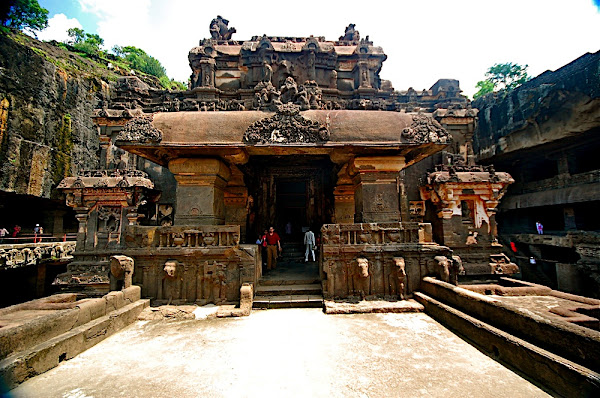
Kailasanatha Temple (also known as Kailash or Kailashnath Temple) is the most spectacular of the 34 monasteries and temples that were carved in the wall of a high basalt cliff at Ellora. It is the largest monolithic structure in the world, twice as big as Parthenon! It was built in the 8th century by the king Krishna I (from Rashtrakuta dynasty) and it was designed to recall Mount Kailash, the abode of Lord Shiva.
The most amazing thing about Kailasanatha Temple is that it was carved out of a single rock. It combines immensity of effort with grace and superb craftsmanship. Apparently, what also makes it unique is that the carvers started at the top of the original rock, and excavated downward, exhuming the temple out of the existing rock. It is believed that it took around 200 years to excavate it, during which 200,000 tones of rock were removed from the site.
The main temple is located in the U-shaped courtyard. It is two-story high and has several rooms, gathering halls and an enormous lingam at its heart - all carved from stone, of course. It is heavily decorated with images of deities, mithunas (erotic male and female figures), as well as other figures. Most of the deities at the left of the entrance are Shaivaite (followers of Lord Shiva) while on the right hand side the deities are Vaishnavaites (followers of Lord Vishnu). At the base of the temple there are statues of elephants, meant to suggest that the temple is aloft.
The courtyard is edged by a columned arcade three stories high. The arcades are punctuated by huge sculpted panels, and alcoves containing enormous sculptures of a variety of deities. Originally, stone bridges connected these galleries to the main temple, but these have fallen.
Kailasanatha Temple, front view:
View to the main Shiva Temple from a side gallery:
Shiva Temple:
One of many pillars:
The whole structure is heavily decorated:
Elephants at the base of the temple:
Second floor of Shiva Temple:
Inside the main part of Shiva temple:
The outer walls of Shiva Temple are heavily decorated:
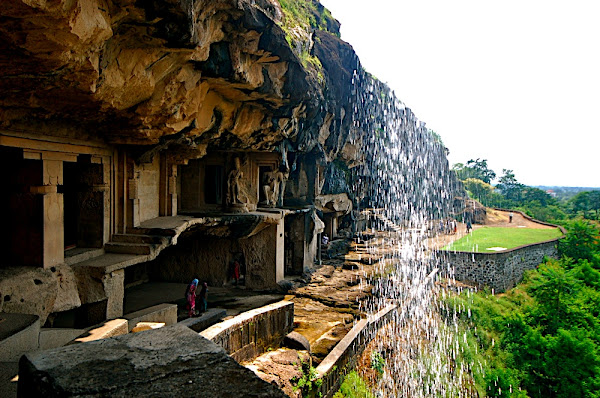
Ellora is an archaeological site that preserves 34 caves/temples belonging to three religions: Buddhism, Hinduism and Jainism. I find it inspiring and admirable that in India those religions could and can coexist peacefully.
Ellora is located 30 km (19 miles) away from Aurangabad and we visited it during the same trip during which we went to the Ajanta Caves. Both cave complexes are very impressive and I would not be able to name the one that I liked more. The Ajanta Caves are in the more pristine location, see less tourists, and have better preserved frescoes. On the other hand, the Kailsanatha Temple in Ellora is the most spectacular of all the cave-temples we saw. I also thought that it was great that in Ellora we could directly compare Buddhist, Hindu and Jain temples (all temples in Ajanta are Buddhist).
The Ellora Caves were excavated out of the cliff of the Charanandri hills between the 5th century and 10th century, during the reign of the Rashtrakuta dynasty. There are 12 Buddhist (caves numbered 1 to 12), 17 Hindu (caves 13–29) and 5 Jain (30–34) caves.
The most impressive cave in the complex is the Hindu Kailasantha Temple (Cave No 16), to which I dedicated a separate post. But also other Hindu temples are very beautiful, each in its own way. They represent different styles and some of them are so complex that they must have taken several centuries to be completed.
The most famous of the Buddhist caves is Cave No 10, a chaitya hall or 'Vishvakarma cave', popularly known as the "Carpenter's Cave". At its heart is an impressive 15-foot statue of Buddha seated in a preaching pose. Most of the Buddhist Caves are large, multi-storied, and included living and sleeping quarters, kitchens, and other rooms.
In contrast to the majestic Hindu and Buddhist Caves, the five Jain Caves are small and have ascetic feel to them. They do have, however, more intricate and exceptionally detailed art works. Also, many of the structures had rich paintings in the ceilings – fragments of which are still visible.