Showing posts with label US travel. Show all posts

Friday, March 1, 2013

Fuming Volcano

To Anil the highlight of our trip to Big Island was the night swim with Manta Rays. To me it was seeing an active volcano. The most active volcano on Earth, in fact, Kilauea, which current eruption has started over 30 years ago, in January of 1983.

During the day, when the sun is high above the horizon, the volcano doesn't look very impressive or scary. Then it's simply a giant hole with a bit of white fume coming out of it. It's during the night when the volcano starts to look both imposing and magical at the same time. I was almost hypnotized by its radiant beauty, and despite the cold of the evening and occasional rain, I felt the red warmth of the volcano working its way through my body to keep me warm, engaged, and happy.

Kilauea at night.


Kilauea at sunrise.


Thursday, January 10, 2013

Scenic Drive through Monument Valley Navajo Tribal Park

I've been to Monument Valley Navajo Tribal Park twice: once in summer and once in winter. Contrary to all the other places in the South-West–which I find prettier and more interesting during winter–I found Monument Valley more scenic during summer.

Monument Valley in Summer


I think there are two reasons for that. First, Monument Valley doesn't get enough snow during winter and, therefore, it isn't uniformly covered by it. To me, the patches of snow make the Valley appear more "messy" and less "monumental." Second, contrary to the summer skies, during winter skies are usually clear and cloudless, which translates to less dramatic views and less original photos.

Monument Valley in Winter


Still, we found the 17-mile Scenic Drive through the Valley very enjoyable and we would recommend it to anybody passing through that part of the world, no matter what time of the year you're there.

Scenic Drive through Monument Valley


The drive took us close to many interesting rock structures, like the two "mittens"–East and West Mitten Buttes–pictured on the photo below.

Yours truly with East and West Mitten Buttes


To some, the rock on the photo below resembles a camel and, therefore, it got named Camel Butte.

Camel Butte


Here are the Yei Bi Chei-­Navajo spiritual gods–and Totem Pole.

The Yei Bi Chei and Totem Pole


Look how small our car is compared to the nearby rocks.

My Love and his red toy in the Monument Valley


Looking back at some of the photos I took during my recent visit to the Monument Valley, makes me see how the Valley got its name. It does look quite Monumental in places.


Wednesday, January 9, 2013

Escape from Civiliazation: Valley of the Gods

If you want to escape from civilization, look no further. Valley of the Gods, mere 40 miles north-east of the world-famous, tourist-infested Monument Valley, has no crowds, no cell-phone or radio reception, no paved roads, no restrooms and/or any other facilities, yet by many it's considered to be more spectacular than its aforementioned famous cousin.


We spent two hours there and saw only one other car somewhere in distance. What a stark contrast to Monument Valley, where you see at least five cars at each single viewpoint or turn of the road. Additionally, there is no fee to enter Valley of Gods, and you're welcome to do there whatever pleases you: you can camp there (again for free), go hiking anywhere you want, or even do some bouldering/rope climbing. Valley of the Gods is yours to play with.


Similar to Monument Valley, the most prominent rocks in the Valley of the Gods have names. These names are typically meant to describe what the rock formation resembles, so for example in the Valley of the Gods you can Setting Hen Butte, Lady in the Tub, Battleship and Seven Sailors. It's actually lots of fun to try to look for those shapes in the rocks.

On the left: Lady in a Tub


There's only one road leading through the park: a bumpy 17-mile-long dirt and gravel road with many steep sections and sharp turns. As I'm a road, not destination, kind of person, I had lots of fun driving there and I loved that each bend in the road hold a surprise: a new rock formation or a new scenery.


The best time to visit the Valley of the Gods is in late afternoon, when the sun is low and the rocks glow in beautiful warm red color.

On the left: Setting Hen Butte


Sunset is a great time too, as it emphasizes the ruggedness of the landscape.


Tuesday, January 8, 2013

Goosenecks State Park

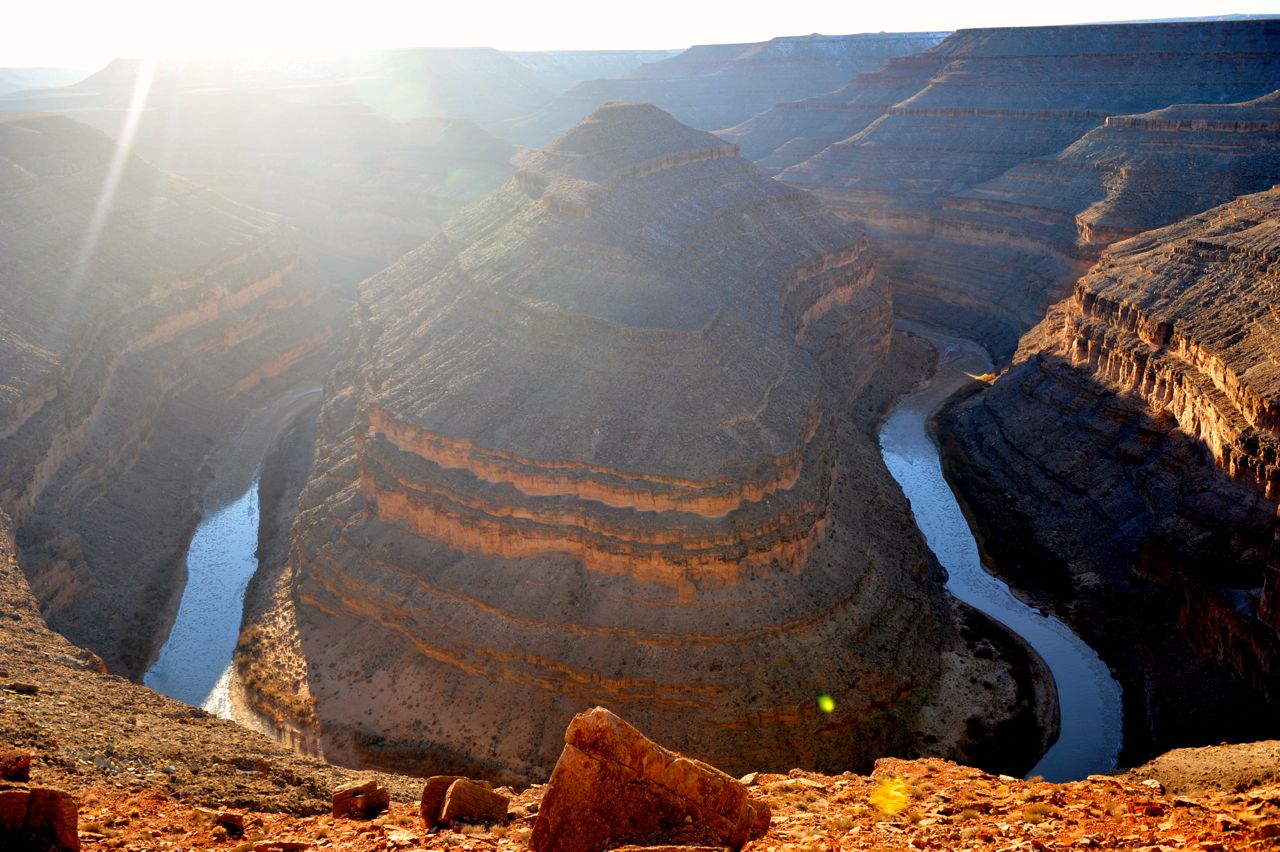
Goosenecks State Park offers a one-of-a-kind scenic view of the meandering San Juan River and the deep canyon painstakingly cut by the river over thousands of years.


Near the viewpoint, the river makes a series of tight turns–goosenecks–which give the park its name.


The viewpoint is located about 1'000 feet above the river and offers a simultaneous view of three of the San Juan River goosenecks. However, even my wide-angle lens wasn't able to fit all of them in one photo. So I'm leaving this to your imagination, or encourage you to visit Goosenecks State Park yourself.


There are no hiking trails in the park and its sole purpose of existence seem to be to provide the views of the river, yet it's worth seeing at least once in your life.


However, if you go there, learn from my mistake and visit the park in the morning or during the midday, as in the late afternoon the sun shines directly above the goosenecks, making photography almost impossible.

Sunday, January 6, 2013

Fascinating Nature: American South-West in a Winter Robe

I have traveled many times through the American South-West, but this last trip was my first winter trip to the region.

To my great surprise, winter appears to be a great time to visit the South-West, possibly better than any other season. The key reason behind that is that tourists seem not to like cold weather and, subsequently, there were hardly any of them in most places we visited (with a small but notable exception of Grand Canyon, which is popular year-round).


The lack of tourists translates to a better overall experience, as witnessing the beauty and splendor of the South-West in solitude is bound to enhance your appreciation of the forces that stand behind the creation of this world's most amazing natural wonder.

Solitude encourages contemplation, introspection, as well as it enhances senses and brings closer the examiner and the subject of examination. In my case, it also led to a realization that American South-West is a Playground of Nature, a place where Nature experimented with all possible rock shapes and forms, before deciding how the rest of Earth should look like.

My second big realization was that this Nature's Playground is My Playground too. I've been very fortunate to be able to travel multiple times through South-West, with time getting to know it as well as my own backyard. This growing intimate knowledge of the region allows me to probe it further and deeper with each subsequent visit, leading to even deeper fascination and admiration for the Nature and its ways.

During the next few weeks I'm going to blog about my favorite places in the South-West, and the way they look during winter.

Here's a list of places I'll rave about:
  1. Valley of Fire State Park
  2. Monument Valley Tribal Park
  3. Gooseneck State Park
  4. Valley of Gods
  5. Canyonlands National Park, The Needless Area
  6. Newspaper Rock State Park
  7. Arches National Park
  8. Canyonlands National Park, Island in the Sky Area
  9. Dead Horse Point State Park
  10. Goblin Valley State Park
  11. Colorado National Monument
  12. Hovenweep National Monument
  13. Valley of the Ancients National Monument
  14. Mesa Verde National Park
  15. Aztec National Monument
  16. Chaco Culture National Historic Park
  17. Grand Canyon National Park, South Rim
  18. Rainbow Bridge National Monument
  19. Vermillion Cliffs National Monument
  20. Grand Staircase Escalante National Monument
  21. Paria Canyon-Vermilion Cliffs Wilderness
  22. Bryce National Park
  23. Kodachrome State Park
  24. Pink Sand Dunes State Park
  25. Zion National Park

Wednesday, November 28, 2012

Light, at the End of the Tunnel

There's hope. I've finally started to organize my photos from the last one and a half year, so the ones of you who are waiting for photos from me might get them soon in the mail.

Below are some photos that I took in April this year in the Upper Antelope Canyon. I've been to the Antelope Canyon twice before, but it was the first time that I saw its famous light beams. It seems that I got lucky and manged to catch all of them.

Next aim: visit Antelope Canyon during winter.


Thursday, February 9, 2012

National Key Deer Refuge, Florida

The Key deer is a tiny (60-75 centimeters tall) endangered deer that lives only in the Florida Keys. The current population is estimated between 600 and 750 individuals. As about 40 Key deer are killed every year in collisions with cars, their status is "threatened with extinction." I was saddened to see that not all drivers obeyed the reduced speed limit that was set up in the areas where Key deer live.

A Key deer

Key deer can be found on one of 25 islands in the Lower Keys, and this region is protected as National Key Deer Refuge. Curiously, Key deer can easily swim between the islands.
 
In search of Key deer, we first went to No Name Key, as the refuge website recommends starting there. However, despite spending over one hour on the island, we didn't seen any deer, big or small. Still, we enjoyed our time there quite a bit: the island was very peaceful, and there were hardly any people.
At the end of the world: No Name Key

Mangrove forest, No Name Key

A hawk, No Name Key

Funky circular seeds, No Name Key

After failing to see any Key deer on No Name Key, which is relatively sparsely populated, I thought we no longer had a chance of seeing one of those little deer on any of the other islands. Well, I forgot that we were in Florida, where animals not only don't hide from people, but instead parade in front of them.

That was the case with the Key deer as well. The very first one (out of three) that we encountered, jumped out directly in front of our car, on a heavily-used road, near the Big Pine Key visitor's center . . . Luckily, we saw it in time and didn't hurt it. It seemed completely oblivious to our presence, and it didn't even mind me getting out of the car and coming within a few meters of it.

A Key deer

I'm very happy that we encountered several Key deer as I wanted to see for myself if they are as small as the Dik-dik. They're not. They are at least twice the height, and five to ten times the weighed of the Dik-dik. In fact, a key deer looks like a juvenile of a regular-size deer, which was a bit disappointing.

In the refuge we also went on two short nature hikes: the Jack Watson and the Fred Mannillo Wildlife Trails, and we also made a short stop at the Blue Hole site. Sadly, both nature trails and the Blue Hole were disappointing, and we didn't see much wildlife there. It seems that this area was affected by fire not too long ago, which might be a reason why there weren't any animals. Maybe in a few years they will come back.

Burned palm trees

The fire exposed the intricate network of fibers in the palm's husk.
The palm's fibers

I love the color of this tree trunk

Anil carefully examines the tree

Tuesday, February 7, 2012

Curry Hammock State Park, Florida Keys

We stopped in Curry Hammock State Park on our way to Bahia Honda State Park.

Curry Hammock is made up of several islands in the Middle Keys. The main entrance to the park is on Little Crawl Key, and this is were we went. We wrongly assumed that a 1.5-mile long nature trail through the hardwood hammock that we planned to hike would start there. Only after we crossed the park's entrance and were handed the park's map we realized that the trailhead for the hike was on a different island.

However, since we the fate brought us to Little Crawl Key, we decided to check it out as well. And we liked what we saw: there was a nice beach where one could swim, snorkel or kayak; there was a playground, picnic tables, grills, restrooms, showers, and very few people. So instead of going on a nature trail, we decided to take a stroll along the beach.

It was a very pleasant walk made interesting by the presence of several seabirds. One of them, a double-crested cormorant, seemed not to be afraid of people at all: it let me get very close to itself and take several close-up photos.

A double-crested cormorant, Curry Hammock State Park

A mangrove tree, Curry Hammock State Park

Curry Hammock State Park