Showing posts with label India. Show all posts

Tuesday, July 10, 2012

Himalayan Viagra

As some of you may know I've recently spent several weeks in Nepal, sightseeing historic sights in the Kathmandu Valley and backpacking the Annapurna Circuit.

While trekking in the high Himalayas I was intrigued to see one local using a toothbrush to clean something that he referred to as "an insect." I was even more intrigued to find out that the thing that he was cleaning was apparently worth lots of money. If I remember correctly the local man claimed that each "insect" was worth at least $10 and I have to admit that I didn't believe him. I thought that either he was exaggerating or he was not too good with numbers.


Shame on me and my ignorance. The "insect" turned out to be the caterpillar fungus–also known as the Himalayan Viagra–the most expensive fungi in the world that sells for about $50,000 a pound.

Caterpillar fungus is a specimen created when a parasitic fungus infects the caterpillar of the ghost moth, ultimately killing and consuming it. After the fungus mummifies its prey underground, it shoots out of the top of the dead caterpillar's head and thrusts out of the soil. It's this tiny protuberance that the harvesters search for each spring.


In Tibet and Nepal the fungus is known as yartsa gunbu, whereas in India it goes by the name kira jari (or Indian Viagra). As you might have guessed from its English name, the fungus is thought to be an aphrodisiac. In traditional Chinese medicine it's also used for a treatment of cancer and aging, and it is used by some athletes as a performance-enhancing drug.

The fungus is especially popular in China where it fetches the highest price (of up to $100,000 a kilo). When sold by harvesters to a middle man, a single fungus fetches about 2-3 dollars, depending on its size and quality. That's much more than the average daily worker's wage, so the search for caterpillar fungus in the Himalayas resembles a bit the Californian gold rush. (Yes, some people even got killed over this precious fungus.)


The good news is that some people are able to collect lots of them in a single day, and use the money to build a house or finance their own or family member's education.


Read more on: BBC, CNN, NPR, or National Geographic.

The "Big Four" Killer Snakes of India: the Count Is Three (So Far)

The "Big Four" is the name given to four venomous snake species responsible for causing the most snake bites in India/South Asia.

During the last three weeks of my stay in India (in the center of 12-million-people metropolis, I should add) three out of four members of this "killer" group have visited our garden.

First, about three weeks ago, we hosted a Common Krait, which venom contains muscle-paralysis-inducing neurotoxin that leads to death by suffocation.

Then, about two weeks ago, a deadly and fearless Naja naja (Spectacled Cobra) made the appearance. Local people seemed to be much more scared of the kobra than they were of the krait. I was told that Spectacled Cobras are very aggressive and, unlike most other snakes, they don't run away when people approach them but instead they attack. That was indeed the case with the kobra that came to our garden. It wasn't at all afraid of the group of five people observing it closely, and it was "starring" back at us with anticipation painted all over its agile body. It was clearly ready to attack if anybody would be foolish enough to make even a one more step in its direction. This suspense lasted a good hour giving me the opportunity to take several pictures of the kobra.

The kobra's venom contains both post-synaptic neurotoxin and cardiotoxin, so it can cause death either by paralysing muscles needed for respiration or by causing cardiac arrest. (Pick your poison, literally.)  

After about an hour, the kobra got bored waiting for the people to leave and decided to look for a more peaceful rest place for itself. Unfortunately, it didn't look far and decided to enter cool and cozy pipes of our house! Needless to say, since then I open the bathroom's door with a lot of caution. I also insist on sleeping with closed windows, despite the heat.

Last week the third member of the Big Four group visited our lot. It was a young Daboia (Chain Viper, Russell's Viper), which is responsible for causing the most snakebite incidents and deaths among all venomous snakes present in India because of its wide distribution and frequent occurrence in highly-populated areas. Daboia's venom induces thrombocytopenia, and eventually leads to death either from kidney, respiratory or cardiac failure, or from sepsis.

The last member of the Big Four group is Saw-scaled Viper. It hasn't visited us yet, but I'm sure that it will. In fact, I expect it to show up this week, as the other three venomous snakes paid a visit with uncanny regularity within a week of each other.

Other frequent visitors to our house and garden include: monkeys, lizards, chameleons, geckos, and squirrels.

Geckos are a very common sight. Every day I see at least twenty of them running on the walls and ceilings of the house. They are very well behave, so we let them live in peace.

The monkeys, on the other hand, are not so welcome, as they occasionally get inside the house and steal food. They can also be quite aggressive and, if threatened, throw sticks and stones at people.

Chameleons are fun to watch, especially as they slowly climb the trees.


Another frequent visitor is a family of squirrels, which makes a nest in Anil's parents bathroom about four times a year. The squirrels have just moved out, as their little ones came of age and were ready to face the outside world. But we do expect the parents to be back with new kids in three months or so.

Orange-head lizards are a common sight too. 
It's nice that we don't even need to leave the house to see all of these interesting animals.

Tuesday, June 14, 2011

Satyanarayan Puja

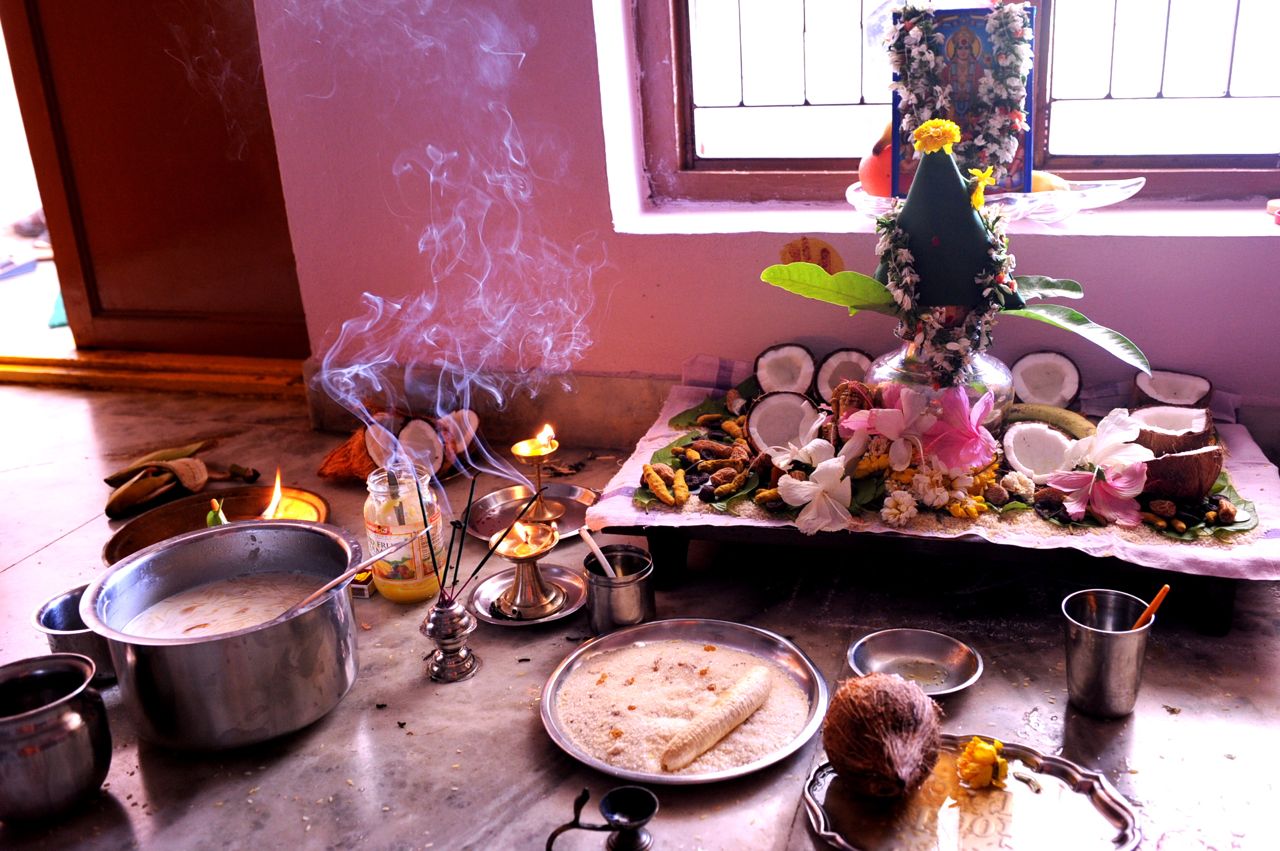
The Satyanarayan Puja is a Hindu ritual performed before/on/after any major occasion like marriage, house warming, engagement, birth of a child, new job, etc. It is also thought to help bear children to couples trying to start a family.

I'm not going to describe in detail the program of the puja, as wikipedia does a good job at that. Suffice to say that our Satyanarayan ceremony took 3 hours 45 minutes and was filled with action. We had to start several small fires, break several coconuts, add oil/ghee/honey/rice to fire, place various offerings at alters of several gods. I believe that at least seven different gods were invited to participate in our ceremony. I guess that's why it took so long :)

Also, during the Satyanarayan puja several interesting stories are being told. Again, I'm not going to describe them here as they can be found elsewhere.

The only complaint that I would have is that the puja is way too long. Try sitting on the floor with your legs crossed for close to 4h and you will understand why I think so...


Sunday, June 12, 2011

Tadoba Andhari Tiger Reserve

It is my opinion that any visit to your family house is not a holiday. There are always so many things to do and so many people to see that there is hardly any time left to rest and relax. I tend to come back more tired from such "holidays" than I was before them... Therefore, I usually try to find at least 2-3 days to visit a new place nearby my hometown, so that I can get a few days of rest as well.

During our recent trip to India we manged to find 2 days to go to Tadoba Andhari Tiger Reserve. To be precise, we were away from home for 40h during which we drove 980km! If you had ever traveled in India, you know how big achievement that is.

Tadoba Andhari Tiger Reserve is one of the best places in India to see tigers. However, only in the park we learned that the best month to see them is May. It is the hottest month, so tigers come out looking for water. We were told that in that month daily sightings of tigers are a common. During other months tigers are apparently only seen on average 2-3 times a week (which means that if you spent 3 days in the park you would have a fair chance of seeing them).

We visited the park in March and, sadly, we did not see any tigers. Still, we enjoyed our visit to Tadoba Reserve immensely. To find such peaceful and serene place in the middle of the world's second most populous country felt like finding a hidden treasure. Tigers, no tigers, I would definitely recommend visit to Tadoba Andhari Tiger Reserve to anybody who wants to escape from mess and overpopulation of Indian cities. As you can see in the photos below, there were plenty of other animals to keep us busy and entertained.

Practical info:
If you care only about tigers, you should visit the park in May. If you choose to do so, you need to book your safari tour at least 2-3 weeks in advance (email me if you want a contact there that can help you with it) as there is a limit on how many cars can enter the park per day. Similarly, if you want to visit the park on weekend during other time of the year, it might be also advisable to book your tour in advance.

The park can be entered in a regular car, but you will see much more if you choose to rent a 4WD (you can do it directly in the park; you can also contact me if you want me to connect you with one of the drivers with jeeps that work there).

The photos below should give you a good idea of the park and animals that can be encountered there.


Sadly, the first bigger animal that we saw in the park was a dead baby sloth bear:

The park is surrounded by marshy area that is inhabited by many birds:


Entrance to the park:


"Animals have rights of way" :)


Elephant on the road:


Deers:


Another funny road sign:


Monkeys:


Ducks:


A bird that looks like a stone:


More deer:


More monkeys:


An eagle-hawk:


Caught in action:


Monkey baby and its mama:


Lesser Egyptian Stork:


Egret:


Two egrets fighting above a crocodile:


A little monkey is learning to climb:


Monkey love:


Sambar:


Two crocodiles:


A wild pig:


Elephants:

Friday, June 10, 2011

Thoughts on Photography

This post is dedicated to people who think that the major factor determining quality of photos is a camera.

Here I provide a proof that that's not the case by comparing two pictures taken by the same camera, of more-or-less the same subject, within seconds of each other. The first photo below was taken by the writer of this post (me), the second by my husband. To make it clear, I do not think that the photo that I took is good (for one, the man on the right has his eyes closed). The only point I'm trying to make is that the photos can be vastly different even if the circumstances and camera settings are the same.

Here is a photo I took (low light conditions, no flash, no post-production improvements):


And this is a photo that Anil took a minute later (with exactly the same camera settings):


Here is Anil's photo processed in iPhoto (it looks better now, but the colors still don't look like they should and half of the photo space is wasted):


So please do not ask me anymore what kind of camera I use. Some of the best photos I took were taken with a compact point-and-shoot camera (and some of the worst with the pro-DSLR camera...)

Wednesday, June 8, 2011

Cooking Classes with Indian Mother in Law

There are benefits of having an Indian mother in law. She can teach you how to cook delicious Indian food :)

During our last few days in India, Anil's mother taught me how to make dosas, idlies, lemon rice, coconut chutney and sambar. I was also able to successfully make those dishes after we came back to the US, so I guess that makes her a good teacher and me a good student :)

Below are six recipes that Anil's mother wrote down for me:
  1. Lemon Rice
  2. Rava Dosa
  3. Coconut Chutney
  4. Dosa
  5. Idly
  6. Sambar

      Lemon Rice

      Ingredients:
      • 5 tbsp tamarind extract (soak tamarind in warm water for 1h, use water later in the recipe)
      • 2 cups rice
      • 1/2 tsp turmeric
      • 1 tbsp urad dal
      • 1 tbsp chana dal
      • fistful ground nuts or cashew nuts
      • fistful curry leaves
      • 1/2 tsp mustard seeds
      • pinch hing
      • 3-4 tbsp oil
      Cook rice. It should be slightly harder than usual and should not be sticky. In a pan heat oil and when hot add dals and nuts. After 1 minute add mustard seeds, hing and curry leaves. After 1 minute add tamarind extract, mix and reduce heat to low. After around 2 minutes (when most of the liquid evaporated) add this mixture to hot rice. Add turmeric (to make it yellow) and salt to taste and mix well. Tamarind Rice (Puli Hara) should be eaten cold and can be stored outside a fridge for up to 2 days. Lemon juice can be used instead of tamarind extract. In that case it is added directly to rice, not spices in a pan.


      Rava Dosa

      Rava dosa is a quick alternative to "real" dosa. It is super-easy to make and it takes almost no time to prepare.

      Ingredients:
      • 1 small cup rava
      • 1/3-1/4 cup of curd
      • 2 cups maida (all purpose flower)
      • water
      • salt
      • finely chopped onions and green chillies
      Mix all ingredients (except onions and chillies) and keep them aside for 5 to 10 minutes so that they become soft. Make dosas on a non-stick pan on medium high heat. Dosas should be very light brown on both sides. If you want to add onions or chillies, do it before dough is dry.  


      Coconut Chutney

      Ingredients:
      • 1/2 cup of roasted chana dal
      • 3/4 cup shredded coconut
      • salt
      • 1/2 green chilli
      • grated ginger
      Grind all the ingredients together. Done! (Anil and I sometimes add a little bit of lemon juice to make it a bit more tangy.)  


      Dosa

      Ingredients:
      • 1 cup urad dal
      • 3 cups rice (old rice)
      • salt
      Soak urad dal and rice separately for around 5h to overnight. Grind rice with very little water. Remove rice paste from the grinder and then grind urad dal with 1 cup of water. It should become very fine. Mix rice and urad dal together in a big bowl and add salt. Keep the dough outside until it becomes slightly sour (from overnight to a day, depending on a climate). Make dosas on a non-stick pan.  


      Idly

      Idly dough has the same ingredients as dosa, but they should be slightly less well grounded. To make idlies one needs a special idly pot. I will post a picture of it at some other occasion.  


      Sambar

      Ingredients:
      • 1 cup Toor dal
      • 1 tsp sambar powder
      • fistful coriander leaves
      • 1 tbsp brown sugar
      • 3 tbsp tamarind extract
      • vegetables - all can be used; you should use either onions or drumsticks
      Cook toor dal and keep it aside. Cook all vegetables together, add tamarind extract, coriander leaves, brown sugar and sambar powder. Boil together for around 5-6 minutes. Add mashed dal and again boil on slow heat for 2 minutes.

      Monday, June 6, 2011

      Family Photos in India

      Our visits to Poland and India were super-intense, filled with lots of events and travels, as well as many visits of and to family members and friends.

      In the photos below there are the closest family members of Anil (his father, mother and grandmother) photographed during several events that we attended in India.


      Mother and daughter:

      Mother in law and daughter in law:

      Father and son:

      Three generations:

      Mother and son: