Friday, December 23, 2011

The Inca Trek, Day Three: Pacamayo to Wiñay Wayna

The third day of the Inca Trail was the most interesting one, as there are many Inca ruins along the way (namely Runkuracay, Sayacmarca, Phuyupatamarca, Intipata, Wiñay Wayna). All of these ruins were very interesting, each in its own way, so I decided that they deserved to be described in more detail, and I dedicated a separate post to each one of them. These posts will be appearing here during the next few days.

The ruins were not the only reason for which the third day of the Inca Trek was interesting. It was the longest day, during which we hiked 15 kilometers, and, for the most part, we walked on the original Inca pavement. We passed two tunnels carved into the rock, and we were surrounded by a magical cloud forest full of orchids, hanging mosses, ferns, and other flowers. Also the views from the trail were spectacular, especially from the top of the second (Abra de Runkuracay, 4,000 meters) and the third pass (3,700 meters). We could see the snow-capped Veronica (5,750m) and Salkantay (6,180m), and the valleys lying at their feet.




But, most importantly, all the ruins we saw along the way were reminding us that we were getting closer and closer to Machu Picchu. We were less than a day away from the culmination of our trip, and we were getting very excited about it. At the same time, we also felt quite peaceful—the beautiful nature has its calming ways. In fact, it calmed us down so much that we didn’t feel the need to wait till midnight to greet the New Year. And even the fireworks, which lasted for a good hour, didn’t motivate us to leave our warm tent, and join the festivities that were taking place at the nearby restaurant. By far, we felt much more excited about the following morning, and we wanted to get a good night’s sleep before the day we had been looking forward to for so long: New Year’s Day in Machu Picchu.


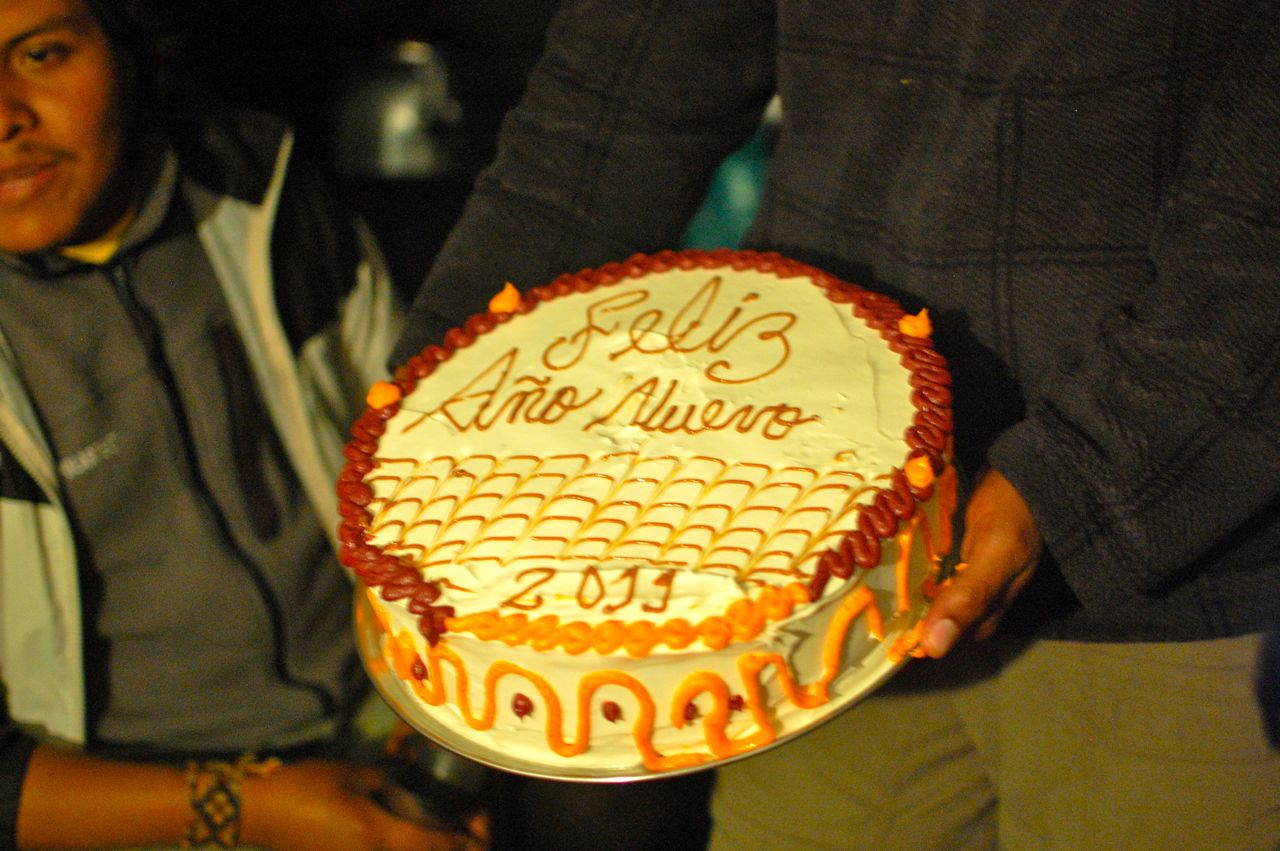
Happy-New-Year-Cake from our amazing cook and porters. Anybody have ever tried to bake a cake while backpacking?

On the last evening of the Inca Trek the porters joined us for the celebratory cake, giving us an opportunity to express our gratitude to them.

Thursday, December 22, 2011

The Inca Trek, Day Two: Wayllabamba to Pacamayo

The second day of the Inca Trail was the most physically challenging. The distance we had to hike was the same as on the first day (12 kilometers/7.5 miles), but the elevation change was much bigger. First we had to climb over 1,200 meters (4,000 feet), and then descend 700 meters (2,500 feet) on steep, slippery and unequal stone steps. And all that at an altitude of 3,500 to 4,200 meters (11,500 to 13,800 feet), which makes breathing somewhat difficult.

The highest pass of the trail is called “Dead Woman's Pass” (Abra de Huarmihuañusca), and many believe that it is named after a woman who died there from exhaustion a few years earlier. Our guide, however, maintained that the name refers to the shape of the mountain near the pass, which resembles a sleeping woman. He could not explain, though, how come the pass was called “dead” and not “Sleeping Woman’s Pass.”


Anyway, before our trip, both Anil and I had been a bit worried that we might succumb to altitude sickness, and have a hard time on that second day of the hike. Neither of us had been so high in the mountains before, so we had had no idea how our bodies would react to the high elevation. So about half a year before the Inca Trek we had started an intensive, self-imposed training program, which involved going hiking every weekend, and walking up and down the steepest hill in our neighborhood at least twice a week. I’m proud to report that thanks to this regime, we were both in an excellent shape; it showed during the Inca Trek, as we could hike much faster than all of our travel companions. On some days we were twice as fast, on others three times as fast, as the slowest person in our group. If we had had to hike as slow as this person, it would have been extremely frustrating for us. But, luckily, our guide quickly recognized that, and allowed us to separate from the rest of the group, and hike at our own speed. It was great for us, as even though we were a part of a bigger group, we felt independent and free to do what we wanted.

I have to admit that even for us (Anil in particular) the “Dead Woman’s Pass” was quite challenging, and we felt a great relief when we finally reached it. We were hoping to take a longer break there to recover a bit, but it was close to impossible because of freezing winds. So, shortly after we took a photo commemorating our achievement, we started a descent to Pacamyo (3,600 meters), where our campsite was already waiting for us (we could see the colorful tents form the top of the mountain). This last bit of the trail was unexpectedly difficult. We were finally walking on the real El Camino Inca, only to learn that the Incas—who could build perfectly shaped and symmetric houses—preferred to build unequal steps. You can imagine that walking down the stairs for about 700 meters can be rather hard on the knees. Now add to this picture steep and slippery steps of varying height, and you’ll understand better why we didn’t enjoy too much this part of the trek. You might be interested to know that we figured out that it is better to run down rather than walk on this part of the trail. But then, you have to be extra cautious not to slip and fall down (as I almost did).

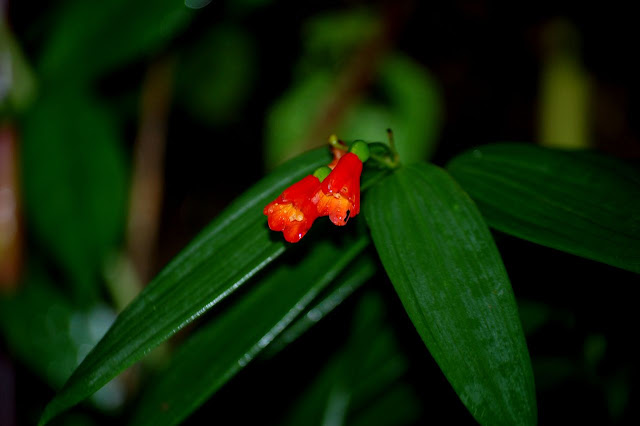
Views and flowers on the way to the pass.


As we were getting closer to the pass, the trail was getting steeper.


Finally there!

On the way down.


Not surprisingly, at the end of that day, we were super-hungry.

Wednesday, December 21, 2011

The Inca Trek, Day One: Cusco to Wayllabamba

The Inca Trail is a 43-kilometer (26-mile) hike through the Andes, culminating at the magnificent Inca ruins of Machu Picchu. The trail follows the ancient El Camino Inca—“The Inca Road,” and passes many impressive Inca ruins, as well as a beautiful cloud forest and mountains. It takes four days to hike this trail, so I decided to dedicate four posts to it: one post per each day we spent on the trail.

The first day of the trek was quite easy and relaxed. It started early in the morning with a bus ride to “Kilometer 82”—the starting point of the trail, from which it was another 12 kilometers (7.5 miles), this time by foot, to the first campsite.

At 5:30 A.M. we were picked up from our hotel, and two hours later we found ourselves at the picturesque town of Ollantaytambo, where we stopped for breakfast. It’s a pity that we didn’t have time to explore Ollantaytambo, as with many well-preserved buildings dating to the Inca times it looked very interesting.

The breakfast gave us the first opportunity to get acquainted with our travel companions for the next few days. It took us just a few minutes to realize that some of them wouldn’t do too well on the trek. One woman was wearing a fancy knee-length coat, a very long pashmina, and fashionable sunglasses that she needed to push back on her nose every few minutes. Her husband wore a bit more appropriate clothes, but had so much trouble filling up their camel bags that I was convinced that it must have been the very first time in his life that he had done it. Then, another family of five only got an idea to buy raincoats and trekking poles the moment our bus was about to depart Ollantaytambo. I’m not sure if I was more amazed by the fact that they didn’t bring the raincoats with them in the first place (we were there in the middle of the rainy season), or that they only decided to buy them after we all boarded the bus, and were ready to leave for the trailhead. Later, we also learned that the same group of people didn’t have enough common sense to plan their trip in a way that would allow them to get acclimatized to the high altitude before embarking on the trek … The sad consequence of that was that they were super-slow throughout the trip, and even experienced some of the typical altitude sickness symptoms, despite taking medication against it.

After we finally managed to leave Ollantaytambo, we drove for another half an hour till we reached a staging area near Kilometer 82. There, our porters were already waiting for us, and as soon as our bus stopped, they frantically started repacking the supplies we had brought (the food, gas bottles, tents, tables, chairs, etc.). By the time our trekking companions were ready to start hiking, most of the porters were already half way to the campsite. Despite carrying a serious load, they had to walk very fast (some of them even ran), as it was their responsibility to set up a temporary campsite and prepare lunch for all of us somewhere along the way to our final destination for the day.

The weather was a bit gloomy when we started hiking the Inca Trek, but our spirits were high. We were all very excited about the adventure that was about to begin. After our hiking permits and passports were checked by a governmental official, we crossed a bridge on the Vilcanota River and followed a trail leading up into the mountains and away from the river.


As we were climbing higher and higher, our enthusiasm suffered a decline; but as the views were getting better and better, it quickly soared back up. The first semi-interesting thing that we saw along the trail were the ruins of a former fort, Huillca Raccay, which controlled the entrance to the Cusichaca valley.


A few minutes later, we encountered the second ruins of the day, which were much more impressive. They go by two names: Llactapata (“Town on the Hillside” in Quechua) or Patallacta, and they were primarily used as an agricultural station that supplied Machu Picchu with maize, the staple crop of the Incas. The settlement was quite extensive and comprised over one hundred buildings. Some of them had been inhabited by farmers, while others by soldiers protecting the access to El Camino Inca and Machu Picchu. Interestingly, during the Spanish invasion, the Incas had burned this site, along with a number of other settlements along the Inca trail, to discourage Spanish pursuit. This strategy has worked quite well, as the Spanish never discovered the Inca trail or any of its settlements, allowing us to enjoy the Inca masterpieces till this day.


After leaving Llactapata, the trail started gently climbing for about 2 kilometers (1.25 miles), before it flattened as it followed the left bank of the river up for another 7 kilometers (4 miles). From parts of this trail there were great views of the Cordillera Urubamba (the Urubamba mountain range) and the snow-capped peak of Veronica (a 5,860-meter mountain).


A hummingbird.

Along the way we passed through several small villages, and in one of them we stopped to have lunch. The lunch was prepared by our porters, but I’m hoping that our travel agency paid some money to the local people to compensate them for the inconvenience caused by our presence.


As you can see in the photos below, the lunch we were served (as well as all the other meals that we received on the trail) was very elaborate. It consisted of a salad, a soup, a main course, and a dessert—not quite the same meal most backpackers are used to while on a long trek.

Examples of salads we were served.


Soup.

Main course.


Typical breakfast.


Sample desserts.


It was a wonderful treat, which we deeply appreciated, but at the same time I just couldn’t stop feeling bad for the porters who had to carry all this food, as well as the chairs, tables, tents, gas bottles, plates, and cutlery that we got to use.


I hadn’t expected such an elaborate setup, and I would have been more comfortable sitting on a blanket spread out on the grass, and eating a simpler meal. I’m not a princess, and I don’t like being treated like one. Don’t get me wrong: if I were super-rich, I would probably hire a chef, a driver, and a personal assistant to work for me full-time. I have no problem outsourcing some of the mundane tasks that I do not enjoy (like cleaning and driving), or do not have time for (like cooking and shopping). What I have a problem with is taking advantage of the inequality in wealth distribution throughout the world, and, e.g., hiring porters in poorer countries for a fraction of the cost it would be in your home country. Either carry your gear yourself, or pay them what you would have to pay to a porter in your own country.


After lunch we hiked for about two more hours before we finally arrived in the small village of Wayllabamba (located at 3,000 meters), where we spent the following night in the campsite set up by our amazing, underpaid porters. There, again, I was shocked to see that each couple was assigned to sleep in a four-person tent, instead of a two-person tent. Could someone explain to me what’s the logic behind that and why the porters have to carry so much extra weight? I, for one, felt extremely uneasy about it, and felt so ashamed that I almost couldn’t look the porters in the eyes. And reminding myself that at least they had jobs, and earned above-average (for their country) wages, was not helping. Small things like this tainted my enjoyment of the nature and the ruins along the Inca Trail, and were the reason I found the Inca Trek morally dubious. I’m not sure, though, what would be the alternative. Maybe encouraging somebody to start a new, “fair-trade-like,“ travel agency?